
Uncategorised
Baby Products Liquidation Pallets for Resale
Jul
A pallet of baby merchandise can turn into reliable repeat business or expensive dead stock. The difference is rarely luck. Buyers who make money with baby products liquidation pallets know what moves in their market, what requires extra inspection, and where a low purchase price does not automatically equal a strong margin.
For resale businesses, baby inventory offers a valuable mix of necessity-driven products, recognizable brands, and frequent replenishment demand. Parents do not stop shopping for bottles, feeding accessories, nursery basics, and seasonal apparel because the economy gets tight. But they do expect safe, clean, accurately represented merchandise. That makes smart sourcing and disciplined sorting essential.
Why Baby Products Liquidation Pallets Can Produce Strong Margins
Baby products cover more than one selling channel. A local retailer can fill shelves with packaged feeding supplies, apparel, bath items, and nursery accessories. An ecommerce seller can build individual listings around branded items with clear model numbers. Flea market vendors and bin stores can turn open-box accessories, clothing, and smaller toys into fast-moving value inventory.
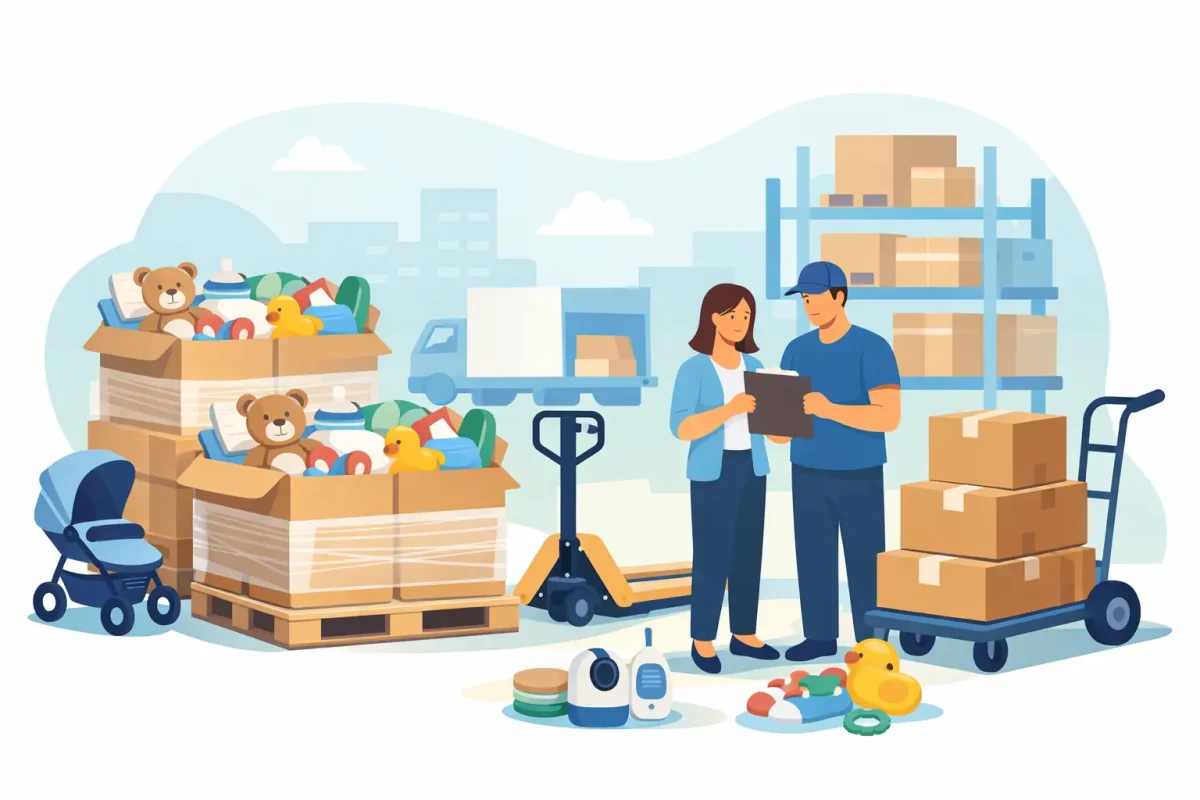
The category also gives buyers variety without forcing them to source dozens of individual suppliers. Depending on the lot, a pallet may include baby clothing, strollers, high chairs, monitors, breast pumps, bottle sets, diaper bags, play mats, safety gates, nursery décor, and developmental toys. That range can help a reseller test several price points at once.
The margin opportunity comes from buying below traditional wholesale cost, then matching each item to the right outlet. A sealed bottle warmer may deserve an online listing. A lightly damaged outer box on a branded baby gate may still be ideal for a local discount store. Apparel with minor packaging issues may move quickly through bins or bundle sales.
That said, this is not a category where buyers should assume every unit is resale-ready. Customer returns can contain missing parts, opened hygiene items, damaged packaging, or products that require testing. Shelf-pulls and overstock often offer a cleaner path for buyers who want a higher percentage of retail-ready units, though the buy-in can reflect that condition. The right inventory type depends on your labor capacity, sales channel, and target margin.
What to Check Before Buying Baby Products Liquidation Pallets
A good liquidation purchase starts with the information available before the pallet reaches your warehouse. Review the manifest when one is provided. Look for brand names, quantities, retail values, condition categories, and product descriptions that are specific enough to support a buying decision. A vague mixed lot may still create opportunity, but it should be priced with more room for uncertainty.
Pay close attention to condition. New overstock, shelf-pulls, and unopened items generally require less processing and can support stronger customer confidence. Returns may offer a lower entry cost, but they require more receiving time. If your operation cannot inspect, clean, test, photograph, and repackage product quickly, a return-heavy lot can tie up cash longer than expected.
Safety and completeness matter more in baby inventory than in many general merchandise categories. Before placing an item for sale, confirm that it has the components needed for normal use and inspect it for cracks, loose hardware, damage, stains, odors, and missing instructions. For equipment such as cribs, car seats, strollers, swings, gates, and high chairs, check applicable recall information and current safety requirements before resale. Do not sell an item that is recalled, structurally questionable, or missing critical safety pieces.
Hygiene is another hard line. Products designed for personal feeding or bodily contact need careful review. Opened bottles, nipples, breast pump parts, pacifiers, teethers, and similar products may be unsuitable for resale even if they appear clean. Build your cost model around the fact that some inventory will be unsellable. Strong buyers plan for that reality instead of treating every listed unit as recoverable revenue.
Before you commit, calculate more than the pallet price. Your true landed cost includes freight, unloading, storage, labor, supplies, marketplace fees, and expected shrink. A $1,500 pallet is not a $1,500 investment if it costs another $500 to ship, process, and prepare. The goal is not to buy the cheapest lot. The goal is to buy inventory that leaves enough room after every cost is paid.
Use a Simple Recovery Model
Start with a conservative estimate of sellable units. If a manifest shows 100 pieces, do not automatically forecast sales from all 100. Estimate the portion likely to be sellable as new, open-box, used, parts-only, or unsellable. Then assign realistic prices based on your actual channel, not the highest retail price shown online.
For example, a pallet may contain 80 sellable items after inspection. If the expected average recovered sales price is $28, projected gross revenue is $2,240. Subtract the purchase price, freight, labor, selling fees, supplies, and a reserve for returns or markdowns. That remaining number is the margin that matters.
This model also tells you when a pallet is a pass. A famous brand and high stated MSRP can look attractive on paper, but poor condition, oversized shipping costs, or slow-moving SKUs can drain the deal. Experienced resellers protect capital by saying no to inventory that cannot hit their required recovery target.
Match the Pallet to Your Selling Channel
The best baby product pallet for a bin store is not always the best pallet for an online seller. Bin operations can profit from broad mixed inventory, package-damaged items, and products that move through volume. They need enough variety to keep customers coming back, and they need a sorting process that keeps unsafe or incomplete goods out of the bins.
Small retail stores often benefit from cleaner shelf-pull and overstock inventory. Packaged feeding supplies, baby apparel, nursery accessories, and giftable branded merchandise can create an organized value section that customers trust. Clear labels and condition disclosure are especially important when selling open-box items.
Ecommerce sellers should favor products with identifiable brands, model numbers, manageable shipping dimensions, and enough resale value to justify handling. Compact monitors, diaper bags, bottle warmers, toys, and specialty accessories may be more practical than bulky furniture. Large gear can still be profitable, but local pickup or regional delivery may make more sense than shipping it across the country.
A hybrid strategy can maximize recovery. List the highest-value, complete products individually. Move mid-tier items through your retail floor or local marketplace. Bundle lower-priced accessories, and use imperfect but safe merchandise for discount events. Separating inventory by recovery channel is how a mixed pallet becomes a planned revenue stream rather than a pile of boxes.
Build a Fast, Repeatable Receiving Process
Speed protects margins. The longer a pallet sits untouched, the longer your cash stays trapped. Receive baby inventory with a process your team can repeat every time: document the pallet on arrival, compare count and contents against the manifest, sort by condition, and isolate products that need safety or completeness checks.
Create clear internal categories such as sealed retail-ready, open-box complete, tested used, parts-only, and do-not-sell. Photograph higher-value items during inspection. Save loose components with the product immediately rather than letting them disappear into a general parts area. A missing tray, charger, strap, or instruction booklet can turn a sellable item into a markdown.
Accurate condition language protects your reputation and reduces avoidable returns. If a box is distressed but the item is new and complete, say so. If an item is open-box, disclose it. If you cannot verify completeness or function, price it accordingly or do not sell it. Trust is a profit tool in liquidation, especially when your customers are buying for their children.
Deal Hunter Liquidation helps buyers access pallet and truckload opportunities across baby products and other resale-ready categories, giving growing businesses a practical way to keep inventory moving without paying traditional retail sourcing costs.
Buy for Turnover, Not Just Retail Value
The stated retail value of a pallet is a reference point, not a promise. Your operation wins when merchandise moves at a price that produces cash recovery fast enough to fund the next buy. For baby products, that often means prioritizing practical, recognizable, easy-to-explain items over slow, bulky, niche products with impressive MSRP.
Watch seasonal timing as well. Baby apparel, outdoor gear, holiday gift items, and nursery décor can all perform differently depending on when they arrive. A great pallet purchased too late may require markdowns that erase the margin. If you have storage and a proven sales history, holding select seasonal inventory can work. If cash flow is tight, buy closer to current demand.
The strongest baby liquidation buyers do not chase every pallet. They build a repeatable standard: inspect the data, price the risk, move inventory quickly, and protect the customer experience. Find lots that fit your channel, leave room for real costs, and give you enough variety to make the next sale happen before the pallet is fully sorted.
